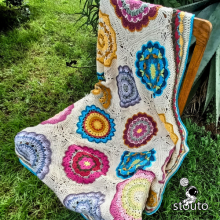
Growing Daisy is a beginner flower granny square pattern and futures a large flower in the center if the flower square pattern. Perfect for any crochet project like cardigans, crochet pants, crochet throw pillows, or even a pretty crochet coat. The easy mandala flower motif is inspired by the flowers that grow in my native country, while the pattern example is worked up in the colors inspired by this majestic flower, one can easily work this pattern in any color of choice.

Digital PDF Patterns include
- Detailed written instructions,
- Per row photo tutorial,
- Shorthand crochet instructions
- Yarn length requirement.
- Color indications are shown in the photo tutorial
- Crochet Blanket Floral Border Pattern included as a separate file
Suggested yarn for pattern.
Photo tutorial and square examples are made up of cotton yarn, this is only used as a suggestion, any yarn of your choice can be used.
Lightweight yarn using a smaller crochet hook will make a smaller square, and heavier yarn using a larger crochet hook will result in a larger square.
Yarn Usage :
+- 500m / 545 yards to complete 3 to 4 large squares, depending on the amount of colors used per square.
Square size: 24 x 24 cm / 9 x 9 inches, based on using a crochet hook size of: 3.5 mm
The pattern featured on this page is part of the complete crochet pattern linked below.
Visit the full pattern page for detailed information, including the complete design, materials, sizing, instructions, tutorials and available pattern options.
**View the complete pattern below and continue your crochet project.**

Estimate the yarn you'll need based on your project size, yarn weight, and stitch pattern.
35% Raverly Sale
Materials used in pattern example
Finished sizes based on below
Difficulty level : Intermediate - Full photo tutorial long side detailed written instructions, to assist with beginner level crochet enthusiasts.
Abbreviations, Glossary, References, Techniques
This pattern is written and charted using standard US crochet terminology.
Special stitch instructions and abbreviations is listed within each flower square pattern
Pattern Notes
The pattern is worked in the round with (RS) right side facing front.
Skills required
- Understand the basics of working in the round.
- Joining different yarn colors and how to end and finish rows.
Techniques used
- Gauge: stick to the same yarn weight and crochet hook throughout making your squares, or your squares will not match up.
- Working in ends, as you go will help you at the end when it comes to finishing the blanket unless you love spending a day at least to work on loose ends.
Pattern notes and Information
The pattern is worked in the round with (RS) right side facing front.
US Stitch Terminology : Abbreviations
-
Double Crochet - dc
-
Front Post Double Crochet - fpdc
-
Front Post Half Double Crochet - fphdc
-
Front Post Treble Crochet - fptr
-
Half Double Crochet - hdc
-
Puff Stitch - puff
-
Repeat from * - rep from *
-
Slip Stitch - sl st
-
Stitches - sts
-
Treble Crochet - tr
All stitch instructions are available in both US Crochet Terminology and UK Crochet Terminology, making it easy to follow along using the terms you are most familiar with.
If you are new to any of the stitches used in this pattern, we recommend reviewing the relevant stitch guide before starting. Each guide includes step-by-step instructions, helpful tips, and stitch terminology conversions where applicable.
Take your time, practice any unfamiliar stitches, and most importantly—enjoy the process of creating your blanket one row at a time.
UK : fpdtr - front post double treble crochet
AFR : vbdsl / vsdsl - Voorste Been Dubble Slag Steek / Voor Stam Dubble Slag Steek
1. Yarn over twice, insert around post front→back→front.
2. Yarn over, pull up loop (4 loops).
3. Yarn over, pull through 2, yarn over pull through 2, yarn over pull through last 2.
Round 6
Join new color in 1 ch-sp, ch3, counts as first leg of * 6dc-shell in ch-sp, repeat from * around, join into the top of start ch with sl, finish off color.
(12 x 6dc-shell in each ch-sp in round)
Round 7
Join new color in sc st between 6dc-shells, ch3, counts as first leg of * 2dc, ch2, 2dc, ch2, 2dc in ch-sp, repeat from * around, join into the top of start ch with sl, finish off color.
(12 x 2dc, ch2, 2dc, ch2, 2dc in each ch-sp in round)
⚠️ This pattern is for personal use only. Please do not copy or redistribute.
Previous buyers can request an updated PDF, or use the free instructions on this page.
Pattern Reference
This page is part of a larger crochet pattern and is intended as a companion tutorial or stitch reference. For complete instructions, materials, sizing information, and all pattern sections, please visit the main pattern page.
African Flower Crochet Blanket – African Bouquet Granny Square Afghan

Create a colourful African flower crochet blanket inspired by the beauty of South African flowers. The African Bouquet Afghan combines eight unique crochet flower granny squares into a vibrant floral blanket, finished with a decorative crochet flower border.
This pattern hasn’t been reviewed yet.
Be the first to share your experience and help other crocheters.
Pattern Copyright & Usage
This crochet pattern and all associated content are the original work of Stouto Crochet.
- ✔️ Personal use allowed
- ✔️ Sell finished handmade items (small-scale)
- ❌ Do not copy, rewrite, or redistribute
- ❌ Do not share or resell PDF patterns
AI & Content Use: This pattern may not be reproduced or used to train AI systems.
Is the Growing Daisy granny square beginner-friendly?
Yes! It's labeled intermediate due to color changes, front post stitches, and working in the round—but the full per-round photo tutorial, detailed written steps, and clear US abbreviations make it very approachable for beginners who've mastered basic stitches (chain, dc, hdc, sl st). Start with the magic ring and follow along round by round.
How big is the finished Growing Daisy square?
Approximately 24 × 24 cm (9 × 9 inches) when using DK/lightweight yarn and a 3.5 mm hook (as in the example photos). You can easily make it smaller (use finer yarn + smaller hook) or larger (thicker yarn + bigger hook). Consistent tension across all squares ensures they join perfectly for blankets or other projects.
What yarn and hook should I use for this pattern?
The example uses cotton DK yarn for crisp stitches and great drape, perfect for the flower details. Any yarn works: acrylic for affordability, wool for warmth, or cotton blends. Suggested hook: 3.5 mm for the sample size. Always match hook to yarn label for best results, and test a swatch if changing weights.
How much yarn do I need?
About 500 m / 545 yards total makes 3–4 full squares (depending on how many colors you use per square). Each round change uses a small amount, great for stash-busting! The more colors, the more ends to weave, but less yarn per color.
Why does my square look wavy or uneven?
Common with multi-round mandala-style squares! It often happens from inconsistent tension, too-tight chains, or not skipping stitches properly.
Tip: Keep tension even, count stitches each round, and block your finished square (wet or steam) to flatten and define the daisy shape and corners.
How do I change colors cleanly in this pattern?
Join the new color in the specified ch-sp or stitch (as noted per round), then work over the previous tail if desired. Finish off the old color after joining with sl st. Weave in ends as you go—this pattern has many color changes, so it saves hours later!
Can I make this pattern in one color?
Absolutely! Skip the "join new color" and "finish off" steps—just continue with the same yarn. The mandala layers and petal texture will still shine through beautifully in a solid color or subtle variegated yarn.
How many Growing Daisy squares do I need for a blanket?
For a standard throw (~40 × 56 inches / 100 × 140 cm): about 35–40 squares (e.g., 5 × 7 or 6 × 7 layout), depending on joining method and border. Add the bonus floral border pattern (included in PDF) for a pretty finish. Use the yarn calculator in the pattern resources if planning bigger.
What’s the best way to join these squares?
Popular methods: whip stitch or mattress stitch for invisible seams, or join-as-you-go (JAYG) for no sewing. Since this is a mandala flower with defined corners, flat slip stitch join or single crochet join highlights the edges nicely. Block squares first for straight seams.
Do you have a video tutorial for this pattern?
The digital PDF includes a detailed per-round photo tutorial (better than video for pausing/zooming on stitches). For visual help with specific techniques (magic ring, front post stitches, puff if used), search YouTube for "US crochet [stitch name] tutorial"—many free videos match the steps here.
Can I sell items made from this pattern?
Yes! This is a free pattern for personal use and selling finished items (limited production). Credit @Stouto's or link back to this page if sharing online. Do not copy/redistribute the pattern itself.